Running Facebook ads without considering timing can quickly drain your marketing budget. If your audience is asleep, commuting, or focused on work, your ad performance may decline, leading to higher Cost Per Click (CPC) and lower conversion rates.
Although Meta’s algorithm automatically optimizes ad delivery over time, scheduling campaigns during high-engagement periods gives your ads a stronger advantage and can significantly improve Return on Ad Spend (ROAS).
This guide explores performance data gathered from millions of social media interactions to identify the best days and times to run Facebook ads, along with practical strategies to help businesses discover their own highest-converting hours.
Best Days to Run Facebook Ads: Quick Overview
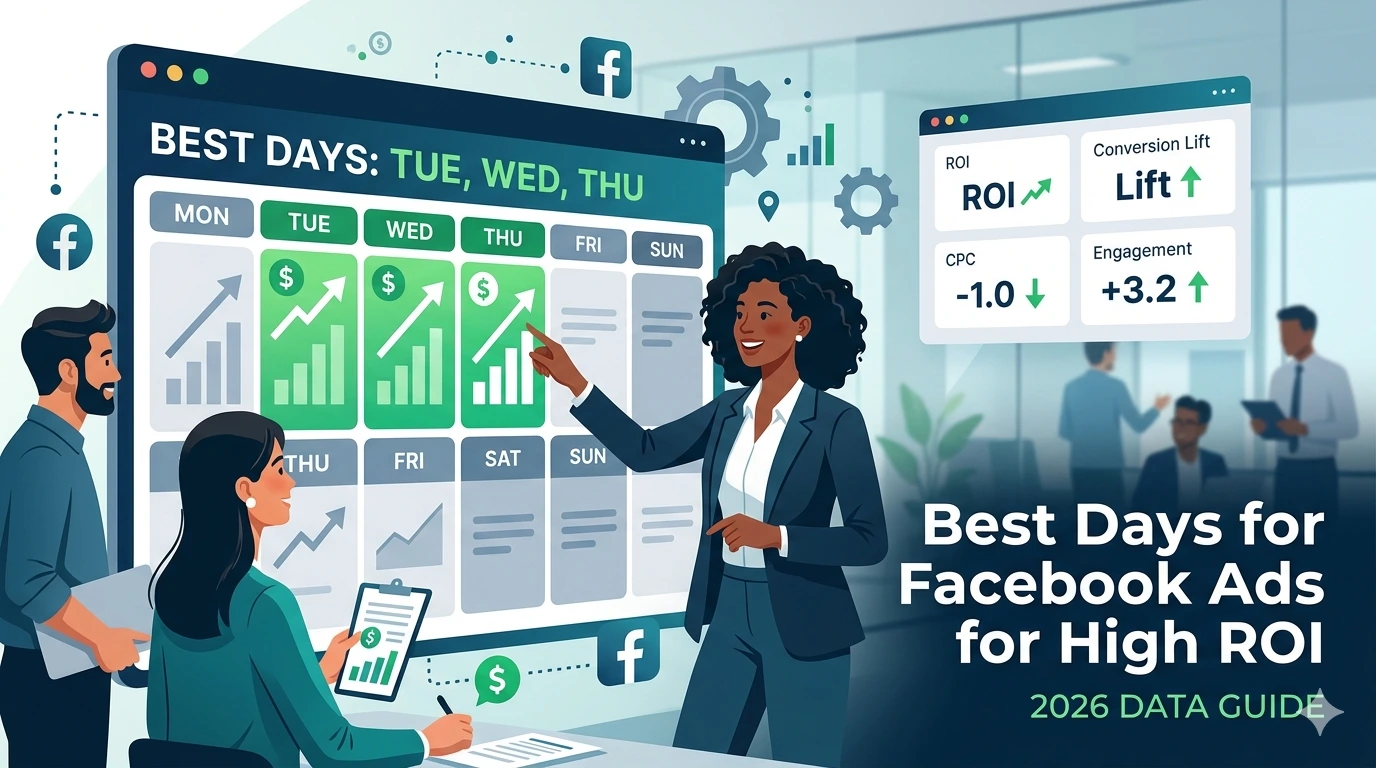
Based on aggregated digital marketing benchmarks, the most effective days to run Facebook ads are Tuesday, Wednesday, and Thursday.
Key Performance Insights
- Top-performing days: Tuesday to Thursday
- Best conversion hours: 9:00 AM – 1:00 PM and 6:00 PM – 9:00 PM (local time)
- Lowest-performing days: Sunday and Monday mornings
- Weakest engagement hours: 11:00 PM – 6:00 AM
Why Midweek Performs Better
During the middle of the week, online user behavior becomes more predictable. Most people are settled into their work routines and tend to check social media during breaks, lunch hours, and evenings. At the same time, purchasing intent and mental focus are often stronger compared to weekends.
Facebook Ad Performance Metrics by Day
Unlike organic social media content, paid Facebook ads rely on both auction competition and historical engagement signals. The following table reflects average cross-industry advertising performance.
| Day | Average Engagement Rate | Average CTR | E-Commerce Conversion Lift |
|---|---|---|---|
| Monday | 3.5% | 2.0% | Baseline |
| Tuesday | 4.8% | 2.6% | +18% |
| Wednesday | 4.6% | 2.5% | +15% |
| Thursday | 4.4% | 2.4% | +12% |
| Friday | 3.9% | 2.1% | +7% |
| Saturday | 2.8% | 1.7% | +4% (mainly B2C) |
| Sunday | 2.2% | 1.5% | -5% |
Organic Posting Times vs. Paid Ad Scheduling
One of the biggest mistakes marketers make is applying organic posting strategies directly to paid advertising campaigns. While the two are related, they operate differently.
Organic Posts
Organic content depends heavily on immediate engagement. Posts that receive likes, comments, and shares shortly after publishing are more likely to gain visibility. Posting while your audience is inactive can reduce reach significantly.
Paid Ads
Paid Facebook ads operate through Meta’s advertising auction system. The platform uses machine learning to determine which users are most likely to convert. However, running ads continuously without scheduling can create unnecessary spending during low-intent hours.
This wasted budget is often referred to as “vampire spend,” where users click ads late at night out of boredom or curiosity but rarely complete purchases or submit lead forms.
Best Days and Times by Industry
The ideal ad schedule depends on your business type and target audience. Different industries experience different engagement patterns.
1. E-Commerce and Retail
Best Days: Thursday, Friday, and Saturday
Best Times: 11:00 AM – 1:00 PM and 7:00 PM – 10:00 PM
Why It Works
Online shopping activity tends to increase during evenings and weekends when users are relaxed. Performance also improves around payday periods, especially near the 1st and 15th of each month.
2. B2B Services and SaaS
Best Days: Tuesday and Wednesday
Best Times: 8:00 AM – 10:00 AM and 2:00 PM – 4:00 PM
Why It Works
Business professionals often browse social media during work breaks or between meetings. Weekend campaigns generally perform poorly for B2B audiences because decision-makers are less active online.
3. Food, Beverage, and Restaurants
Best Days: Wednesday, Thursday, and Friday
Best Times: 10:30 AM – 12:30 PM and 4:30 PM – 6:30 PM
Why It Works
Food-related ads perform best shortly before traditional meal times, when users are deciding what to eat or where to order from.
4. Healthcare and Professional Services
Best Days: Monday through Thursday
Best Times: 9:00 AM – 12:00 PM
Why It Works
Users tend to handle financial, medical, and administrative tasks earlier in the week, making this period ideal for professional service advertising.
How to Schedule Facebook Ads Using Dayparting
Dayparting allows advertisers to control exactly when ads appear, helping reduce spending during low-conversion periods.
Steps to Set Up Ad Scheduling in Meta Ads Manager
- Open Meta Ads Manager and create a new campaign.
- Choose your campaign objective.
- Navigate to the Budget & Schedule section at the Ad Set level.
- Change the budget type from Daily Budget to Lifetime Budget.
- Click Show More Options.
- Enable Run ads on a schedule.
- Select the specific days and hours when you want your ads to run.
Meta automatically adjusts scheduling based on the viewer’s local time zone, ensuring ads display at the correct hours in different regions.
Frequently Asked Questions
Is it Better to Run Facebook Ads on Weekdays or Weekends?
For most industries, weekdays — especially Tuesday through Thursday — deliver stronger engagement and lower CPC. However, some B2C industries such as fashion, entertainment, and impulse-buy products may still perform well on weekends.
Should Facebook Ads Run 24/7?
For new campaigns, it is usually best to run ads continuously for the first 3 to 7 days. This gives Meta’s algorithm enough data to identify your ideal audience and conversion patterns.
After collecting sufficient data, advertisers should review performance metrics and limit ad delivery to the highest-converting hours.
Why Are Facebook Ads Spending Money at Night Without Conversions?
Late-night users often browse casually rather than with purchasing intent. While they may click ads, they are less likely to complete purchases or fill out forms. This behavior contributes to unnecessary spending without meaningful results.
How Often Should Ad Creatives Be Updated?
To maintain strong click-through rates and avoid audience fatigue, ad creatives should typically be refreshed every 2 to 3 weeks. Repeated exposure to the same visuals can reduce engagement and lower conversion performance.
Final Takeaway
Industry benchmarks provide a useful starting point for scheduling Facebook ads, but your own campaign data should always guide final decisions.
Regularly review reports in Meta Ads Manager by using the Breakdown feature and analyzing results by day and time. Identify the hours generating the highest returns, then concentrate your ad budget on those profitable windows.
The most successful Facebook advertising strategies combine platform data, audience behavior insights, and consistent optimization to maximize ROI.