Managing business finances can be challenging, especially for small business owners who handle sales, expenses, payroll, savings, and budgeting at the same time. A Small Business Financial Planner Template provides a simple way to organize financial information and make better business decisions.
Whether you run a retail shop, freelance business, online business, service company, or small startup, a financial planner can help you understand where your money is coming from and where it is going.
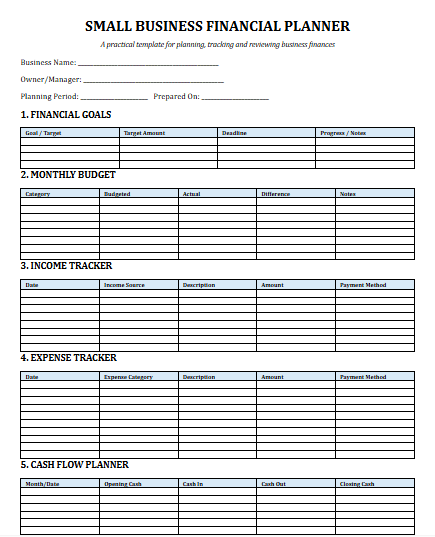
Download the Small Business Financial Planner
Our Small Business Financial Planner Template can save time by providing a ready-made structure for organizing your business finances.
Instead of creating financial worksheets from scratch, you can download our editable template and customize it according to your business needs.
What is Included in a Small Business Financial Planner?
The exact sections depend on the template, but a comprehensive Small Business Financial Planner Template may include the following sections.
1. Business Financial Goals
This section allows you to define your short-term and long-term financial goals.
Examples include increasing monthly revenue, reducing expenses, building savings, purchasing equipment, expanding the business, or reaching a specific profit target.
2. Income Tracker
Use an income tracker to record money received by the business.
You may record:
- Date.
- Income source.
- Description.
- Amount received.
- Payment method.
- Total income.
Tracking income helps you understand how much revenue your business generates over a specific period.
3. Expense Tracker
The expense section helps you record and categorize business spending.
Common categories include:
- Rent.
- Utilities.
- Salaries and wages.
- Inventory.
- Marketing.
- Transport.
- Internet and communication.
- Equipment.
- Software and subscriptions.
- Office supplies.
- Professional services.
4. Monthly Budget
A monthly budget allows you to estimate your expected income and expenses before the month begins.
You can compare your planned amount with your actual amount to see whether you stayed within your budget.
5. Cash Flow Planner
Cash flow planning helps you monitor the movement of money into and out of your business.
It can help you anticipate periods when cash may be limited and plan accordingly.
6. Profit and Loss Overview
A profit and loss section provides a simple way to compare revenue against expenses.
A basic calculation is:
Profit = Total Income − Total Expenses
This gives you a clearer picture of your business’s financial performance.
7. Savings and Emergency Fund
This section can be used to set savings targets and track progress toward them.
Business savings can help prepare for unexpected expenses, seasonal changes, equipment replacement, or future business opportunities.
8. Debt and Loan Tracker
If your business has loans or other debts, a debt tracker can help organize information such as:
- Creditor or lender.
- Original balance.
- Current balance.
- Payment amount.
- Due date.
- Payment status.
9. Financial Review
A financial review section allows you to evaluate your business at the end of each month or quarter.
You can review what went well, where expenses increased, whether revenue targets were achieved, and what needs to change.
FAQs About Small Business Financial Planner Templates
What is a small business financial planner?
A small business financial planner is a document used to organize and manage business finances. It can include income tracking, expense tracking, budgeting, cash flow planning, savings goals, debt tracking, and financial reviews.
Why does a small business need a financial planner?
A financial planner helps business owners monitor their money, control expenses, set financial goals, and make informed financial decisions.
Can I edit a small business financial planner template?
Yes. If you download an editable Word or spreadsheet version, you can customize the template to suit your business.
What should I track in a small business financial planner?
You should consider tracking income, operating expenses, budgets, cash flow, savings, debts, financial goals, and profit.
Is the Small Business Financial Planner suitable for startups?
Yes. Startups can use a financial planner to establish budgets, set financial goals, estimate expenses, monitor revenue, and plan their cash flow from the beginning.
Final Thoughts
Good financial planning is an important part of running a successful small business. A Small Business Financial Planner Template gives you a practical system for organizing financial information and monitoring your business performance.
By regularly tracking income, expenses, budgets, cash flow, savings, and financial goals, you can gain a clearer understanding of your business finances and make more informed decisions.
An editable financial planner also allows you to customize the document as your business grows and your financial needs change.